DOMESTICATED BEASTS of KOS
A Beast is a creature which is too large or strange to be an animal.
1. Herd Beasts - very important for labor + trade. large, stupid and slow, good for hauling carts & meat. this term is used to describe any livestock kept for the aforementioned purposes. endlessly proliferate pagentries of horns, frills and antlers.
2. Carnivorous Goat - goats have evolved to eat anything, including humans. Swift omnivorous scavengers with 6 legs, crab-like shell on the back, and fangs. Produce sweet milk and wool, and are thus kept as livestock despite their dangerous nature. Steamed legs are a delicacy
3. Pack-Lizard - large, slow-moving lizard used for desert travel.
4. Riding Lizard - deinonychus-sized speedy predators, used as deadly light calvary
5. Riding Bird - exceedingly swift, can fly in short bursts and uses wings to propel self when running or jumping. used as courier mounts
6. Blood-Beast - provides nourishing blood, useful for drinking in lieu of water. Nutritious Blood can also ferment to form a thick alcoholic slurry, or mixed with ground grains to provide a protein-rich gruel. This gruel is sometimes boiled in cases made in the small carapace of the Blood-Beast's thorax, and then allowed to congeal into Blood Pudding - a rare treat on the march. Immobile and otherwise almost worthless
7. The Chained Artifact
8. Scrap-Beast - road-tribes sometimes construct these golem-like creatures from scrap wood, small structures, and bits and pieces of other large animals. Family groupings then live atop and travel upon these ungainly engines
9. Armor-Beast - large and loud mixture of insect, dinosaur, crustacean and pachyderm. Used as steeds for ultra-heavy shock cavalry, or goaded forth as living siege engines. long, banner-like tails slowly change color to match the coat-of-arms of the owner
10. Pavilion-Monsters - large pachyderms outfitted with various spikes, hooks, palisades and fighting platforms to deter attackers. Used as mobile fortifications and personnel carriers during battle.
11. The Tower-Monster - local name for a enormous brachiosaurus with a small keep built onto its back
12. Riding Snail - very slow, but able to crawl up vertical surfaces. retracts into shell when it perceives danger, whether the owner would prefer or not
Showing posts with label Monsters. Show all posts
Showing posts with label Monsters. Show all posts
Sunday, March 16, 2014

Wednesday, October 2, 2013
HOW ANIMALS (and lots of monsters) FIGHT (in Kos)
In ancient times, the Gods (in their wisdom) divided all animals & monsters into two types:
1. ANIMALS THAT LOVE TO STOMP & ROMP
2. ANIMALS THAT ALWAYS FLEE
the Gods aren't perfect, though, and most creatures do a mixture of both.
TYPE 1: ROMPIN' STOMPERS
Those That Stomp use the Rampage Circle Style of Combat (some humans use this style too - including berserkers, Blood Bull worshipers, and other desperate / mentally unstable people).
the attack power of a Type 1 animal or monster (or a person using the Rampage Circle Style) is dependent on its size, strength, endurance, and desperation.
- Smaller than a medium dog: -1
- Smaller than a medium dog: -1
- is pretty big and strong, like between a wolf and a tiger - +1
- is really big and strong, like a bear or a buffalo - +3
- is enormous and overwhelmingly strong, like a rhinocerous or a triceratops - +5
- is truly huge and monstrously strong, like a brontosaurus or an elder serpus - +8
- is unusually ferocious (tiger, hyena, displacer beast) - +1
- is unfathomably, unreasonably ferocious (troll-wolf, tyrannosaurus) - +2
- protecting young or a mate - +3
- wounded - +1
- badly wounded - +2
- in its lair - +1
- has powerful natural weapons, such as giant claws or powerful jaws - +1
- has supernatural weapons, such as acid for blood or firey breath - +3
Add up these bonuses. This is the amount of "attacks" it can make. Anybody entering its range is subject to these attacks. The full total of the bonuses can be applied in one attack against one character, or it can be divided against a number of attackers.
OR, it can make a SPECIAL ATTACK. these depend of the type of animal, but here's some example:
- POUNCE: monster jumps at you. you get a free attack if you're aware of it and can respond, but if you're flat-footed, caught off guard, etc it's an automatic success. animal can knock you down. and at that point, you're on the ground with a tiger/bear/whatever on top of you
- CHARGE: bull through / over enemies, trampling them / knocking them down
- ATTACH TO VICTIM: some monsters tend to attach themselves to people - ticks grab on and suck blood, crocodiles bite + shake, wendigos grab and then strangle, etc. usually, this involves an initial attack, and then further automatic damage every round until the victim finds a way to get it off OFF GET IT OFF GET IT OFF
- DIVE-BOMB: some creatures can fly, and this is often how they attack. the dive-bomb involves swooping in, making an attack, and then swooping away. the defender get an attack of opportunity, but only 1 attack per Fight mod (minimum 1). if the dive-bomb is a natural 1, the attacker accidentally crashes into the ground or something. flying creatures don't normally end their turns in melee distance, so all you can do is attempt to shoot it or attack it as it dive bombs
- sting/venomous strike/breath weapon etc ???: the "everything else" category
TYPE II: THOSE THAT FLEE
will come later
Monday, September 30, 2013
COMMON ANIMALS of KOS pt. 1: RIVERS/LAKES
Once, there were ordinary animals in Kos. Dogs, hawks, and fish are some examples. These types of animals, though rare today*, formed the "base creatures" which compose many of the animals which exist in Post-Cataclysmic Kos.
In game terms, this is for those times when you need to say "Dungo the Luckless rolled a 1 on his Fieldcraft check and succeeded only in bringing in [vermin] for dinner..." or "Your last biscuit is suddenly snatched by a..."
first, select an interesting-sounding creature or roll d12 for one
then, in case you need to know, roll 1d4 to discover what these creatures actually are and what they do
d12
1. Great Swan
1. Enormous swans, always black, large enough to pull boats, totally docile
2. very large and territorial but otherwise normal swans
3. not really so "great" after all; this appellation is a fancy of inebriated local river-men
4. large swans, always come in matched pairs of black & white, mate for life. Considered good omen for love
2.Ebon & Ivory Eel
1. they're just black and white eels.
2.-4. come in both colors, but only appear together over the location of sunken treasure
3. Peckel
1.-4. this is what all uninteresting fish are called
4. Drowned Lady
1. an actual dead ghost of a drowned lady who tries to tempt lonely men to a watery tomb. Usually effective only on the deeply inebriated, badly wounded or suicidally depressed
2. a fish which is created when an unloved woman dies, they are considered exceptionally tasty by certain jaded epicureans and valuable in several alchemical processes. Hard to catch, though, because you have to sing a true love song to get them into a net.
3. A fish with pliant flukes on the sides of the face that resemble the hair of a woman.
4. A frog that has beautiful hair and appears to be flush-cheeked and red-lipped; sings loudly at night
5. Soil-Fish
1. a spiny fish which dwells under the sand and is very uncomfortable to step on.
2. a bottom-sucker or cat-fish
3. slang term for any fish considered unfit for human consumption
4. a minor magical creature which draws nourishment from dirt and leaves everything sparklingly white; large fleets are often spotted cleaning the teeth of sea-monsters
6. Savage Pike
1. descendants of former battle-pike of the Aquatic Southland Invasion. Bred to chew holes in the bottom of boats and attack anything flailing around in the water. Otherwise eat only small peckels.
2. Crocodile-sized monsters, highly territorial but easy to avoid on land
3.-4. the same as a normal pike but incredibly vicious, using a strong thrashing motion to rend prey and attacking anything that moves; easily spotted by the constant thrashing a school of them makes at all times as they constantly fight for dominance
7. Knight-Fish
Knight-Fish are covered in armor, and
1. Totally subservient to a golden Emperor-Fish, and follow him in silver swarms. Have lance-like horns attached to their foreheads.
2. carnivorous fish which attack other fish by ramming them
3. beautiful fish admired for shimmering scales
4. small fish that aggressively try to defend small "fortified" areas
8. Emperor-Fish
1. local name for a dunkleostus spotted in the river
2. Large, yellow pufferfish, so named for the pompous look it presents when it puffs up
3. Fish with a large fin strung with iridescent semi-precious accumulations of sand
4. mistranslated South Land name for "whale" or "small volcanic island", re-imagined as a fanciful beast
9. Glittering Crab
1. vicious but beautiful little predators with crystalline shells. Painful to step on, and sharp pincers
2. bio-luminescent flashes allow them to find one another in the dark. Considered appealing by song-writers and other sentimentalists in certain parts of Kos
3. Highly organized expansionists. Always attack in squares, with one crab facing out each direction. Make sorties onto to land and kill small lizards and insects. Only come out at night, where the moon reflects on their shells
4. a type of tiny crab that collects shiny objects. usually has a small hoard of minor treasures
10. Snake-Fish
1. just a common name for any aquatic snake or eel
2. the Northern Snakehead fish we have now, except much worse. They are plotting to invade and settle, and most humans are not yet aware.
3. actually the infant form of the Serpus, who must travel to water to lay her eggs
4. a brightly-striped fish with a venomous bite
11. Nautili
1. are quite numerous in the River Kos and are said to be sacred to God Kos. Some believe they are the souls of river-worshippers.
2. have survived the Cataclysm remarkably well. Sometimes become so numerous during the spring melts that men claim they could cross the River Kos without wetting their boots
3. are considered a pleasant species, tasty and attractive in their jetting swarms. a staple of life for many people, their spiral shell is said to represent infinity and rebirth
4. Held as the emblematic animal of Kos, frequently featured on heraldry
12. the Submerged Crawler
1. Kossick translation: "horseshoe crab"
2. Kossick translation: "Trilobite"
3. Kossick translation: "crawfish"
4. a type of minor magical creature which burrows under the sand and eats ancient detritus; can only be seen by the lump it makes as it travels near the surface. Produces an irritating rash if stepped on.
OLD FISHERMAN'S LYRIC
Nautili, Nautili, you are a friend of mine;
Your whole life is in a spiral, but mine seems stuck on a line
*except dogs in the vast countryside of Barbarian Krax. don't worry, they're actually doing fine
Monday, April 1, 2013
ON THE ROADS - WANDERERS in KOS
ON THE ROADS - (some) WANDERERS in KOS
When traveling the roads, PCs will encounter many other people traveling from place to place. The Incantation for Safe Travel only prevents
non-sapient monsters and Bleed-Throughs from treading upon the road; other humans and beastmen are eager to relieve travelers of their valuables.
Make a check every 2 turns
Near a city: 85% of 1 encounter, 40% chance of 2 simultaneously
Near a town: 50%
Near a village: 25%
Near a bridge: 25%
Everywhere else: 5%
Most of the time, there will be a visible dustcloud to indicate the presence of another party at 1/4 miles. however, if the encounter roll was double-digits (as in, 77, 88, etc)
then a curve in the road or a hill pass blocks the other party from view until the last second, at which point you will be in Close Encounter range. Characters with survival training
or extraordinary senses may be able to avert surprise; this is left to the DM's imagination of circumstance
i
1. HOSTILE
2. CARAVAN
3. ADVENTURERS
4. PILGRIMS
1. HOSTILE ENCOUNTER
1. slavers
2. raiders
3. brigands
4. louts
5. local villain
6. "toll keepers"
7. con men
8. monsterfolk raid
9. Dust Devils
10. Wayward Knight
2. CARAVAN
1. 1d20 freemen to market, +1d10 tradesmen, 50% chance of 1d6 youths armed with simple weapons, 25% chance of local authority figure (elder, warrior, etc).
2. 1d20 farms from market, same as above but with smaller, more valuable possessions (+1d20 gold)
3. moving away - 1d3-1 freeman and his family carting all their posessions on an pack lizard. eager to know road ahead, know little of area
4. messenger - carrying an important message of some kind. Heavily armed, well-paid and with an ill-tempered and very fast riding-bird
5. 1d4 x 1d4 haunted-looking people. they have seen ghastly things and wander without purpose
6. LOCAL FIGURE & RETINUE
7. surly locals - pretend to be traders/huntsmen, unwilling to trade, will give deliberately false and dangerous advice
8. mishap - blocking the road and causing annoyance is an overturned cart, vicious donkey, etc. delay of 1d4 hours (checking for encounters meanwhile)
9. Slaves for sale
10. Jon Mith
11. "Rooster"
12. rich folks traveling with large retinue
13. Soldiers - templars, knights, light infantry, cavalry, heavy infantry, mixed units, mercenary band, militia, free companies
14. evil caravan in disguise - yellow morths wait in the carts among other horrors
15. giant mammalian creature carries a small town on its back
16. fortune tellers! forecasts! lucky charms!
3. Adventurers
1. 1d2 MERCENARIES. Currently looking for work (50%) or already on a mission (50%). friendly with any other members of
the Mercenary Brotherhood. In general, their advice can be trusted. Mercenaries often travel together for mutual protection.
2. 1d3 Skalds, willing to play for money or teach new song for 100 Lunars
3. traveling smith
4. Philosopher a) looking to hire somebody to get something, b) visiting a special and dangerous place, c) visiting a local friend, d) seeking muscle to take somewhere dangerous for little reason
5. peddler / tinker
6. woodsmen
7. prospector(s)
8. adventuring gang
9. Enigmat
f the encounter roll is 00, you have encountered one of the Six Slain Thanes or the Pale King himself. Pray to your Gods for clemency
Wednesday, March 27, 2013
MONSTER-FOLK, MONSTERS, ANIMALS, etc
MONSTER-FOLK
Monster-Folk is an all-inclusive term for sapient human-like creatures who have one or several extremely abnormal attributes [relative to the human standard]
This classification includes humanoids who are part animal (centaurs, minotaurs, wolf-heads, dog-people), humanoids who display characteristics of multiple monsters
or animals (myreauthogue, mauristatia, mongrelmen), humanoids that look like humans but with abnormal features (snitch-men, filchers, ogres) or creatures which are sapient
but clearly unrelated to humans in any other regard (zutt, mercanes). Many of these folk have always existed, but since the Great Cataclysm their numbers and varieties
have exploded. Many are hostile to humans, but it should be remembered that the majority are not "evil". Nonetheless, many humans have a policy of "kill on sight". In most human societies, they are received as second-class citizens or worse.
MONSTER
Monster is an all-inclusive term for unintelligent creatures who display composites of animals attributes (frog-dogs, cave-lice, serpi), have magical abilities (cave-anglers, gem-spiders), or otherwise
show drastic deviation from pre-Cataclysmic animal norms (chop-hawks, lowders, kraw, Pelgrane). They are generally hungry, predatory and unafraid of humans.
Monsters have always existed, but never in such great numbers or so many differing forms as they do now.
ANIMAL
Animals are unintelligent creatures who existed before the Great Cataclysm and continue to do so in a largely unchanged state. Some animals such as Kossic Hounds
and Carnivorous Goats could debatably be classified as monsters, but since they are largely domesticated, people consider them animals.
The primary difference between a "Monster" and an "Animal" is that an animal responds according to basic needs and stimuli - hunger, fear, discomfort, desire to mate, etc
Monsters, on the other hand, behave according to laws which are largely foreign to humans and "normal" animals. they may assume a hostile attitude without any logical provocation, behave in a manner which seems irrational, or seemingly defy presumed laws of physics and physiology. they are often belligerent
BEAST
Beasts act like animals but are unusually large or otherwise dangerous to humans
BLEED-THROUGHs (also known as Ghosts, Demons, Dimensional Flotsam, Undead) are inhabitants or elements of the Other World (sometimes called Under-world, Otherworld, Spirit World, Afterlife, or Anti-Space) which
manifest themselves in the material world. These manifestations take innumerable forms. All are inimical to life and to the substance of existence in general. They are generally uncontrollable and
unfathomable.
Tuesday, March 19, 2013
Alright, listen / WESTERN WILDWOOD
i'm just going to start posting my notes. i don't have time*, ever, to update a blog with actual posts / essays / etc, although i admire very much those who do. so instead, i'm just going to start posting my notes, in unadulterated and unedited format. many of them will not be original, good, or even faintly coherent, but i dunno. maybe there will be some ideas here and there for people to swipe. here's an example
WESTERN WILDWOOD
Ferocious caws are audible from up to a half-mile distant. Here, a murder of 15 Gorecrows are attempting to fight off an invasion of 5 Chop-Hawks.
The Gorecrows have been living in the branches and in a hollow halfway up a large tree hanging out over the cliff for many generations now, but the Chop-Hawks
want it because of the superior vantage point it offers over the nearby Wildwood. Both groups are willing to fight to the death, although if the Gorecrows
become badly wounded they can be seen flying into the large hollow in the tree order to hide (where they will make a last stand). Gorecrows are well-knowwn
to collect trinkets, and they have a few objects in the hollow of the tree (which is somewhat dangerous to reach). Inside, amidst a huge amount of nesting,
eggshells, some lizard and mammal corpses, and other bird stuff, can be found
a) a human skull with some shreds of flesh & hair still attached. belongs to a former member of a gang in Amble Edge and is inhabited by his ghost. if touched, capable of communicating very faintly that it desires to be returned there, where it will haunt the gang forever (because they drove the skull's original owner off, hence his ignominious death at the hands of birds)
b) a simple gold ring consisting of two paralell bands.
c) a necklace of 2 large gold coins strung together, each about half the diameter of your palm. One coin bears an emblem of a shield, and the other a spread-winged eagle. belonged to a member of a defunct knightly order
d) a small, cheap, gold earring, with a setting where a gem was once attached.
e) some junk - part of a belt with buckle, a tangle of copper shavings, and a dented and battered tin cup.
COMMON CREATURES d20
1. Carnivorous Goats (infinite number)
2. Fanged Impalas (3 herds of 3d12)
3. Gem-Spiders
4. Gore-Crows
5. Chop-Hawks
6. Lizards
7. Lowder
8. Kraw
9. Giant Slugs
10. Fire-Flies (night only)
11. Yard-Long Crawler
12. Bale Snail
13. Screaming Crickets
14. Snakes (Boa, vipers, Stake)
15. 1 Tyrannosaur lives in eastern Wildwood (there was a mated pair, but one was slain by a man with a sword. The remaining dinosaur is a female who is afraid to leave her eggs)
16. 1 flock of Blaggers sometimes floats overhead
17. 1 Bagu lives in south-eastern wildwood
18. 2 Leopards roam the forest. Their lair is a willow tree
19. 1 Giant Bear roams the forest
20. 2 Corbins (not affiliated with each other- night only)
SAPIENT CREATURES d8
1. Ulnot the Leaf Collector - strange little blue man on the run from intergalactic mercantile authorities. sells potions at illegal prices. rare things = better potions. Mercane will pay a hefty reward for his whereabouts
2. The Blue Knight - challenges everybody to duels for some reason. very insistent. very skilled fighter. wears blue platemail, rides a giant blue horse, and has a blue sword + lance + shield + tent + flag. when armor is removed he is revealed to be a giant half-blue half-normal human with stupifyingly bad hygiene.
3. The lonely carnivorous goat herder - nice old guy. can talk to goats. sells goats / goat-related products. desirous of news from the outside world.
4. Gunder the evil animal trainer - travels with 1d8 random mammals (1. Bear 2. Leopard 3. Wolf 4.Double-Wolf 5.juvenile giant leopard). trains his animals to kill people and bring back the treasure. feared throughout the forest
5 - 6. Hunter (1d4:
1. Amble Edge Hunter - amiable, folksy, violent
2. Amble Edge Gang Member - conducting nefarious business
3. Northman Hunter Group - 1d3 northmen, friendly but taciturn, willing to trade walrus tusks, sea-lion pelts, or even their famed Giant Longbows for metal goods
4. Tark the Croc-Man: very friendly for a crocodile-man; exiled from Crocodile-Man society for religious crocodile reasons)
7.-8/ A small tribe of Ape-Men. act like the apes from the beginning of 2001: a Space Odyssey. Led by a shaman who can summon ape-ghosts in the form of flying screaming ape skulls that harass enemies
OTHER STUFF
1. Fallen pukel pole. Connects to two defunct Pukel generators and 1 inert Pukel Man (stats as stone golem). Can only be operated/understood by devout Kos worshippers
2. Mortally wounded tyrannosaur atop man with silver sword - sword is Space Alien
3. Corpse has some *minor random treasure but a viper beneath - Ref save or get bit then Fortitude or take 1d6 damage per round for 1d6 rounds
4. Treasure-Moth - glowing moth always leads to nearest major treasure. attacking it is a dire sin (-1d100 respect from ancestors, superstitious people)
5. Yellow area... (see DUNGEON ALPHABET)
6. The birds here have a defense mechanism in the form of song that makes beings become confused and fall asleep, and there are carnivorous vines and lichens nearby to reap the spoils. Fieldcraft save of best Fortitude character or everyone falls asleep for 1d20 hours and finds they have lost most of their treasure to sticky trees. if you roll a 1 you are being swallowed by a carnivorous tree when you wake up. no treasure
7. There are a number of sticky slime-covered vines here, and a small but opportunistic hyena pack lurks nearby. the vines stay sticky even if cut, and can be used for various purposes including making a powerful glue; they are highly flammable (but resistant to acid). Fieldcraft save of most Skilled character or get stuck + attacked by hyenas if you make any noise trying to get free (Violence check or something better)
8. Touching a shriek-vine will cause it to emit a high-pitched ultrasonic whine, which predators have learned means
there is food nearby. Fieldcraft save of most Skilled character or +85% chance of encounter
9. Candlebloom is a small, wierd little plant that emits light at night to attract insects. Useful as a dim candle. Goes
out 2d2-1 hours after being plucked, growing gradually dimmer in the meanwhile
10. SERPUS ATTACK
*by "time", i mean motivation
Friday, March 16, 2012
MYREAUTHOG

Sapient Humanoid
Omnivore (prefer meat)
Found In: Plains, Forests, Caves, Settlements
The MYREAUTHOGUE are large, beastly humanoids resembling a cross between an ape, a wolf, a boar, and a man. They range from squat, short beings the size of a chimp to massive monsters the size of a wagon. They have large, canine ears which can swivel independently, heavy brows, long snouts, and mouths full of fangs. They highly prize arms and armor.

Myreauthogue worship entropy, in the form of a great maw which devours all "food". "Food" in the Myreauthog vocabulary is defined as anything and everything. Varying forms of important food are the saints and demi-deities of the pantheon.
The religious center of Myreauthog life is the butcher's pit, which is never empty and surrounded by totemic ancestor-masks. These masks must constantly be fed with dripping meat to ensure continued survival and prosperity of the Myreauthog race.
The Great Lords of the Myreauthogue are indeed terrible folk, rising to massive size through conquest and tyranny, for a Myreathog’s size is highly variable and mostly based upon his thirst for power. They are fell and terrible lords, who demand much from their minions.
MYREAUTHOGUE AS PLAYER CHARACTERS
Myreauthogue gain +1d6 Violence Power and +1d6 Endurance, but this only persists as long as they eat five times the normal amount of food that a human would require every day. They vastly prefer that this food take the form of fresh meat, but their bodies are capable of ingesting any organic material (grass, bones, paper, etc). If they are unable to consume meat, they instead require about ten pounds of vegetable matter to supply their extremely rapid metabolisms.
Myreauthogue cannot increase their physical attributes through training as humans and most other races do. Instead, they grow in size and strength as they become more masterful in battle. Every time a Myreauthog survives a bloody battle, subtract his current Violence Power from 50. The result is his percentile chance of increasing in size. If he increases in size, over the next several days he will grow and gain +1 to Endurance and Violence Power. Every two times he grows, he will require an extra days-worth of rations every day from that point onwards.
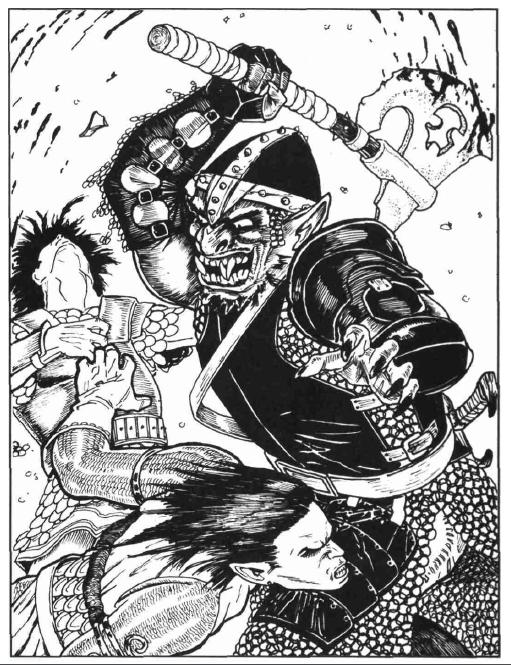
VARIANT TYPES
10% of Myreauthogue display strains of mutation. 1% display two or more.
(roll 1d6)
1. Winged Myreauthog
Wings allow him these Myreauthogue to glide for short distances - about 50 ft. from a high vantage point. They may safely descend from any height, as long as they have about 10 ft. of space to unfurl their wings.
2. Charred Myreauthog
Blackened fangs, red fur, and a smoky stench are clues to the ability of these Myreauthogue to belch flames in a 10 ft. gout, dealing 1d10+1 fire damage (or half for a successful Speed roll). They prefer their meat charred.
3. Gape-Jawed Myreauthog
Cavernous mouth lined with shark-like fangs gives these creatures a powerful bite dealing 1d8+3 damage. Myreauthogue with this attribute are considered blessed by the Maw, for it allows them to consume food at a truly grotesque rate.
4. Horned Myreauthog
Cannot wear normal helmets, but can head-butt enemies dealing 2d4+1 damage. This attribute is seen as a mark of virility amongst Myreauthogue.
5. Giant Myreauthog
Some Myreauthogue are subject to giganticism and reach heights of over 12 feet. Add an additional +3d4 to Violence Power and Endurance, but Giant Myreauthogue require 10 times the daily sustenance of a human, and tend to unfortunate stupidity. They are viewed as very valuable by other Myreauthogue for their excessive strength.
6. ???
MYREAUTHOGUE AS MONSTERS
Least Myreauthog
These are the omegas of the Myreauthogue pack; young adults who have not yet survived to any great size or accomplishment. They are clad in the most rudimentary of pelts and wield rude clubs and spears; any metal they own will be prominently displayed.
Medium Myreauthog
Large Myreauthog
Great Myreauthog
Myreauthog Chief
Myreauthog Lord
Great Myreauthog Lord
Chaplain of the Maw
Great Chaplain of the Maw
Saturday, March 10, 2012
MORTH

Bleedthrough (low-level)
A Morth is an evil spirit inhabiting the body of a dead man. Generally slow-witted and violent, they have an impulse to murder.
Morth characteristics (for those who are desirous of such things):
d10
1. Rubbery, slimy amphibioid flesh
2. Sloughing, rotten flesh
3. Distended, hanging maw
4. Huge, staring lamp-like eyes
5. Long, multi-jointed, grasping arms (can attack from 10 ft. away)
6. Long talons (1d6 damage unarmed)
7. Produces an eerie gobbling noise
8. Constantly growls and wheezes low in the throat
9. Grizzled, milky appearance, as of someone who died of frostbite
10. Shambling gait
AC: 12 (unarmored) or 13 (tattered armor)
HP: 11
Damage: Crude weapon or claws: 1d6 or 1d4
Morths can detect living beings at a distance of 20 feet, and will move to engage. Their movement is generally slightly slower than that of a living man. They are too unintelligent to make use of cohesive tactics or traps, but they will use whatever weapons are close to hand. They can be destroyed by hacking to pieces, but any remnants capable of clutching (head, hands) will remain "alive". Only by removing the ability to clutch (destroying the fingers, shattering the skull to pieces, removing the jaw, etc) can they be permanently destroyed.
Morths generally dully enact whatever functions they performed in life - for example, a Morth who lived as a brigand will lie in wait for travelers, kill them and hide their wealth. A Morth who lived as a laborer will continue to mindlessly stack stones atop one another until his fingers wear to dust. Morths can sometimes be observed communicating with each other through vague moans and babbling, but what (if anything) they are capable of conveying is beyond the knowledge of living men.
Monday, March 5, 2012
Cave-Angler

Academic Name: LOPHIIFORME
Animal
Carnivore
Found In: Caves
Cave-Anglers are a common sight in wet caves throughout Kos. These amphibians have glowing appendages which exert magical attraction on those who view them, causing the victim to foolishly head towards the light and wait to be bitten.
The normal prey of the Cave-Angler is unfortunate small rodents, lizards and floating shrimp, but it is perfectly willing to try anything. If it accidentally attacks a large animal outside its prey range (ie, a human ), it will let go and attempt to escape. Too late for the unfortunate human to avoid being bitten, though - the Cave-Angler's teeth are numerous and wickedly hooked, and its mouth more than large enough to accommodate a hand up unto the wrist.
13 AC
1 HP
Attacks: Bite +0, +6 versus hypnotized characters
1d4 damage
Special: Hynposis
Creatures looking directly at the Cave-Angler must save vs POW at +1 or else become hypnotised and spend their following turn attempting to move to the Angler and present the most convenient extremity to be bitten.
Once the Cave-Angler has made a successful bite, it generally scurries away in search of smaller prey.
No. Appearing: 1
I stole this idea from an excellent post on the "Dungeon Dozen" blog, found here
http://roll1d12.blogspot.com/2012/02/dwellers-in-lightless-pits.htm
strongly recommended
Wednesday, February 29, 2012
the Gruesome Man of Wander Marsh

Bleedthrough (mid-level)
Found in: Wander Marsh, north of IRIDESCENT GROTTOES
The Gruesome Man is usually found atop his coffin, stirring his ever-simmering stewpot and whimpering for new additions to it. The coffin and stewpot move around, and are always found in a different marsh-clearing. He is likely to attack anyone interloping in his territory - bodies make fine additions to the stew. He can smell blood to a distance of one-hundred feet and will attack those attempting to sneak by him. However, quick-thinking adventurers who attempt to parley may be able to buy him off with the offer of a horse, several weeks' rations, or an unfortunate hireling.
The Gruesome Man is found around the marsh north of the Iridescent Grottoes and south of the Lake of Misery, where legends say he died. The monster-folk of the Grottoes know him well and avoid him at all costs. His presence guards one of the entrances to the Grottoes - the stream that pours in from the marshes to the Water Chamber.
SHERIFF DRONLAN THREE-SWORDS of Pilgrim's Passing has offered a bounty of 30 Gold Wheels for the head of the Gruesome Man.
 AC: 16
HP: 21
Attack: claws +3 x2
Damage: 1d8+3 damage each
If both claw attacks hit, the Gruesome Man has made a successful grab and will attempt to rip a piece of flesh off for his stew-pot. Next round, unless forced to retreat, he will attempt an opposed strength check at +6. If he succeeds, the target loses 3d8+3 HP and one limb or equivalent-sized chunk of flesh. the Gruesome Man will retreat with his prize to the stew-pot and will not pursue enemies unless attacked.
The Gruesome Man will only die if his coffin is destroyed by burning or hacking to pieces. It has 12 HP and no AC. He always knows when his coffin is being attacked, and will return to it to kill those attempting to destroy it.
If the Gruesome Man is reduced to 0 hit points without his coffin having been destroyed, he will fall down "dead" but will reform and come back to life in 1d6 hours. If his head or any portion of his anatomy has been removed from the main trunk, this portion will also come alive, and the remainder of his body will come searching for it.
Thursday, February 23, 2012
ALLIGATOR/CROCODILE-MEN

Monster-Folk, Intelligent
Carnivore (Saprovore)
Found: Swamps
ALLIGATOR-MEN (and their cousins, CROCODILE-MEN) are destructive, swamp-dwelling Monster-Folk. They worship obscure and alien deities. CROC-MEN and GATOR-MEN are bitter enemies, and will launch frequent punitive raids to destroy one another's eggs and slaughter birthing females. The only substantive difference between the two sub-species is that GATOR-MEN prefer freshwater, whereas CROC-MEN prefer salt.AC: 12
HP: 12
Attacks: Bite +2
1d8+3 damage
When in swampy environs, a GATOR-MAN or CROC-MAN may lie perfectly still and simulate the appearance of a log, giving himself +5 to Stealth.
Thursday, February 16, 2012
LOWDER

Animal, Unintelligent
Omnivore
Found: Everywhere - primarily Caves, Forests
Common Name: LOWDER
Academic Name: BATHO-NOMOUS
Large, vibrantly blue pill-bug-like creature, the size of a toddler (~2 feet long, ~35-40 pounds). Moves mindlessly in search of small prey and forage. LOWDERS pack a powerful magic attack that wallops enemies using concentrated sound projected from their thorax. The sound is deafening and the vibrations sufficiently powerful to cause blunt trauma. LOWDERS are not aggressive towards humans or other large creatures, but will attack if threatened. Their carapaces and innards glow brightly in darkness.
AC: 10
HP: 5
Attack: Wallop +0
1d6+1 (Attacks the legs of a normal-sized standing human; optionally: struck creatures may stumble, fall or damage knees/shins/ankle. Generates loud noise. 30% chance of causing deafness)
Deafness duration, 1d6:
1-2. 1d4 turns
3-4. 1d4 minutes
5-6. 1d4 hours
Bio-Luminescence: brightness of a candle.
+8 climb. Can cling to ceilings and walls.
No. Appearing:
1d6 small swarm
10d3 colony
Wednesday, February 8, 2012
KOHLE, the GRAY MAN of the WEST

KOHLE is roughly nine feet tall, and massively muscular. His skin is a steely-gray color. He is not easily wounded, and even when cut, he bleeds only a tiny amount of pearl-colored fluid.
Though his exact nature remains a mystery, it is known that he has some method of controlling MAURISTATIA, and uses them to raid caravans. When a merchant-train passes along the GREAT NORTH ROAD outside his TRADE-HOUSE, he unleashes the Mauristatia to create mayhem and panic. In the wake of carnage, he and his small band of elite monsterfolk raiders purloin valuables and slaughter any resistance. Through this method, he has struck fear into the hearts of traders and is slowly but surely isolating PILGRIM'S PASSING from trade. Fortunately for the inhabitants of the Passing, he seems content to merely waylay passer-by, and has not launched any attacks on the town (perhaps believing the rewards to be beneath his regard). Nonetheless, his stranglehold over the GREAT ROAD has lead SHERIFF DRONLAN-THREE SWORDS to place a bounty of 35 Gold Wheels on the gray man's giant head.

one square = 5 ft.
The Trade-House is a solid, square building built from gray brick and covered in plaster. It has weathered the years well, except for some crumbling in the exterior walls. The ceiling is flat and made of wooden boards.
1. This entry hall is the first bastion of defense. The exterior doors face out on the NORTH ROAD. They are of solid, oak construction, reinforced with cross-bucks and iron rivets and attached by old, rusty hinges. Because they open outwards, they are very difficult to force inwards and are easily barred from the inside.
2. This room is where KOHLE and his two ALLIGATOR-MAN cohorts reside. The doors are of solid oak construction. The one that leads to ROOM 3 is normally kept barred and barricaded, to prevent entry from the MAURISTATIA into this room. The two Alligator-Men are brothers, and prefer to sleep on a nest-like pile of straw, broken wood, branches and old cloth in a corner of the room. KOHLE sleeps on a massive cot, piled with a mixture of silks and furs, all pilfered from passing caravans. Near his cot is an iron chest, filled with the ill-gotten gains of the bandit gang. The chest is locked, and KOHLE wears the key around his neck. Opening the chest without pressing down on the lid at the same time will cause a needle tipped with poison to spring out from above the lock, pricking the hand of the victim and forcing them to Save vs Poison or else be dealt crippling agony in the form of 1d10+1d6 damage. Inside are 600 Silver Moons, and an okenite goblet worth 200 Moons, . KOHLE and the Alligator-Brothers will normally be found here, unless out gathering food, raiding caravans, or attending to other miscellaneous business.
ALLIGATOR-MEN
They are swathed in ragged cloaks and a mixture of hides, leather, chain and layers of cloth. They wield a cleaver-like weapon with a long haft for two-handed use.
AC 14
HP 11, 14
Attacks: Cleaver +2
1d8+3 damage, +10% chance of infection from dirty blade
Mauristat
AC 10
HP 12
Attacks: Bite +2
Damage: 1d6+1, 10% chance of causing hallucinations, +10% chance of infection
4. This room is where KOHLE stores more bulky items that he and the Alligator-Men have little use for. They can only access this room when Mauristatia are out hunting.
The door is of similar construction to the ones in ROOM 3.
Contents:
150 pounds of dried Carnivorous Goat meat. KOHLE and his Alligator-Men have been subsisting off this for some time. The gnawed-on nature of these jerkies render them worth about 20 Lunars for the whole load.
80 pounds of hides - mostly Fanged Impala and Great Llamas, but one Leopard skin worth 10 Gold Wheels by itself. The remainder is worth 90 Lunars.
2 large rugs from Southwest Kos or possibly the Holy Countries, worth 10 Wheels each. Each weighs about 50 pounds.
40 pounds of iron ore, worth 80 Lunars
A 40-pound basket mostly filled with catlinite finished goods - cups, bowls, jugs, etc. Worth perhaps 50 - 60 lunars. Most valuable are several limestone idols of the major gods, tucked in protective cloth wrappings, worth about 10 lunars each or more.
KOHLE
He wields a massive, shining sword. He clads himself in leather armor along with a strange turban bearing a blue beryl gem in the center.
AC: 16
HP: 21
Attacks: Tulwar +3
1d8+4, 10% of causing victim to faint for 1d8 turns
TULWAR is a magic sword, with a white blade of tirulium that is feared for its ability to make enemies faint. KOHLE believes he is invincible so long as he holds it.
KOHLE'S other most prized possession is his TURBAN of MAURISTATIA CONTROL. The wearer of this magical turban can force up to 12 Mauristatia to obey orders, at the cost of one Spell Point per command. Commands must be fairly simple - "come here calmly"; "attack those men"; etc. A character with no Spell Points will be unable to use this item. KOHLE uses it twice per day - when the sun sets, he orders the Mauristatia to "be calm and go outside to hunt", then unbars the doors and allows them to file mindlessly past. At daybreak, he uses it again to order them to "be calm and come back inside the Trade House", then waits until they have all filed into ROOM 3 and bars the doors. The rest of the time, he meditates and rests to regain his Spell Points. When a caravan or travelers come by, he orders the Mauristatia to attack them and unbars the doors. When the attack is over, he orders them back inside.
KOHLE has 4 Spell Points, but knows no spells.Were the Mauristatia ever to break free from their confinement, they would happily attack KOHLE and his Alligator-Men, given the opportunity.
KOHLE'S TACTICS
KOHLE is over-confident and feels he has nothing to fear from attackers. He usually posts one of the Alligator-Men somewhere along the road, to watch for caravans. The Alligator-Men are not particularly attentive and have +0 to Notice.
If KOHLE is alerted to the presence of a small group, he will not immediately bother to use the Magic Turban but will instead charge into combat, followed by the Alligator-Men. Only if things turn against him will he release the Mauristatia, using them as cannon-fodder. If he is killed and the Turban does not find a new owner, the Mauristatia will roam freely over the countryside and will probably have little interest in continuing any ongoing battle unless sufficiently enraged.
Saturday, February 4, 2012
SLITHE

Bleed-Through from Between-Worlds (low level)
Common Name: SLITHE
Academic Name: PHLOGISTON
SLITHES are a substance or creature from the Gap Between that has assumed a semi-corporeal existence in the material world. They are believed to be a very basic manifestation of that realm, or perhaps part of the realm itself. Like all Bleed-Throughs, they are antithetical to all physical matter; in the case of SLITHES, they "eat" it away by touch. In the material realm, their state seems to act something like a liquid, which will move downhill unless otherwise arrested. Thus, they are often found in pits or water sources. They are drawn to organic creatures, and will move towards them. They eat away all materials, but more solid, dense material seems to take longer to dissolve. They can lie on stone, for example, for years without significantly damaging it. Water also seems mostly insoluble with their nature. Substances dissolved by a SLITHE will break down in fractal patterns as the component molecules cease to exist. A creature wounded by a SLITHE will not suffer burning or abrasion; the portion that touched the SLITHE will simply cease to exist, revealing a perfect cross-section of veins, muscle-fiber, fatty tissues, bone, etc. They are nearly invisible on land, and appear only as a blurry, mostly transparent smear of dark gelatin. In water, they are visible by the water that they displace. They can also be detected by the smell of ozone that accompanies them. They are plainly visible as faintly glowing, amorphic plasmic shapes to those with Witchsight. They cannot be harmed by physical means - any weapon used to attack them will pass right through and be eaten away. Only magic can harm them, or abjuration by a cleric. They're totally amorphous, but occupy a volume roughly equal to 2 or 3 gallons of water.
HP: 5
AC: None (Magic Missiles and such will automatically hit)
Creatures being attacked by a SLITHE must make a Skill save to avoid touching it. The first time it touches the creature, it will dissolve whatever armor they wear. The second time and each time thereafter, it will deal 4d4 damage.
No. Appearing: Solitary, or 1d3
Every once in a while, a huge congregation of 10d12 will be found oozing across the landscape (very rare)
FROG-DOG


Carnivore
Found In: Forest, Wasteland, Mountains, Caves, Swamp
Common Name: FROG-DOG, CAVE-TOAD
Academic Name: BUBO
FROG-DOGS are voracious predators. They have a tendency to swallow whole and think later. Despite this, some of them are actually alarmingly intelligent, and capable of setting up ambushes and coordinating group attacks. It is unknown if they have any societal structure or culture to speak of. They have extremely strong jaws. They mostly subsist on lizards, giant insects, and small mammals, but will readily go after larger prey.
FROG-DOGS do not mate as normal animals do. They are born from eggs lain by FROG-DOG QUEENS, which are enormous and corpulent. Not all FROG-DOG colonies have a queen, but all large ones will. FROG-DOGS will fight to the death to protect their queen, whereas otherwise they are inclined to withdraw when severely wounded.
FROG-DOGS who have been "spayed" by having their spear-tongues and fangs removed are sometimes kept as pets.
They're the size of a very fat and oddly shaped large dog (~3 - 4 feet long, ~60-75 pounds, with some large specimens growing up to 6 feet and well over 100 pounds)
HP: 11
AC: 13
Attack: Spear-Tongue +1(10 foot range) or Bite +2
Spear-Tongue 1d6+1, Bite 1d10+2
Special
BUBOES have an 8-foot tongue coiled within their cavernous mouths, which is tipped with a barbed piece of cartilage. They can extend this to attack foes, and if it hits, they can pull the foe towards their mouth, Scorpion-"Get-Over-Here"-style. The target must make a Violence Power check at -3 or be dragged 5 feet closer to the FROG-DOG each turn. The tongue can be severed to break the character free; it has an AC of 15 and 1 HP. If the tongue is severed, obviously that toad can make no more attacks with it.
BUBOES are naturally camouflaged and receive +4 to hide when lurking amongst rocks or in underbrush.
BUBOES have sticky-padded "hands". +8 climb, can cling to ceilings and walls with ease.
No. Appearing:
Small colony - 1d4
Medium colony - 1d8, 15% chance of QUEEN
Large colony - 2d10 + QUEEN
WENDIGO

Monsterfolk, Semi-Sapient
Omnivore (prefer flesh)
Found In: Caves
Common Name: WENDIGO
Academic Name: Unknown
WENDIGOS are generally shy and retiring creatures, but fond of human flesh. They look like brown Wampas. They are not very intelligent, and will usually concentrate attacks on one opponent. They hate the sunlight, and only lair in dark caves, which they leave at night to hunt. They will attack anyone entering their den, but will not pursue outside of it. Their normal diet consists of nocturnal animals and cave-animals, but they are capable of surviving off tubers and fungus. They are afraid of fire and magic. Foolish adventurers may mistake a WENDIGO lair for a bear-den, but Wendigo lairs have a particular musk. They are the size of a grizzly bear or Big Foot. (~7.5 feet tall, ~400 pounds)
HP: 21
AC: 13
Attacks: +3
1d8+4 damage
Hugely strong: +5 to strength checks of any kind
No. Appearing: Solitary
Occasionally, a powerful overlord will capture several for use as labor or defense.

Sunday, January 29, 2012
MONGRELMEN

Monsterfolk, Sapient
Omnivore
Found in: Caves, Deep Forest, Ruins
Common Name: MONGRELMEN
Academic Name: Unknown
Common Name: MONGRELMEN
Academic Name: Unknown
MONGRELMEN resemble small men, covered in parti-colored fur, with long bare fingers and a lemur-like face. Quick moving, they covet shiny objects. For unknown reasons, they especially value crystals and gems. They like to nest in groups with a communal stash of treasures. Their lairs may be high up in places hard for most humans to reach. They sleep curled up in balls. Hard to hit but easy to kill. Because they are physically impuissant and meek by nature, they are often found bullied into the service of more powerful monsters. Unless under the leadership of more belligerent creatures, they prefer parleying to fighting, though they possess an irrepressible urge to purloin goods. Potential diplomats would be well-advised to check their pockets after any dealings. They may be very eager to acquire glamorous gems, and will readily barter for them. When they do have to fight, they always prefer to do so from ambush. Their culture has no concept of personal honor, and they will attempt to flee if quickly outmatched.
There are no Mongrelman heroes or magicians, because they consider having low POW to be wise and good. Sometimes, though, a shamanic leader will arise. They will probably be armored, unlike their kin, and may have a collection of items which can create magical effects, but will evince little interest in commanding their kin or consolidating power beyond the collection of valuable objects. Their language consists entirely of borrowed sounds from animals and other monsters - bird whistles, rodent chatter, canine barks, etc.
They can mimic sounds, and modulate their voices to incredibly loud volumes (125 decibels or more). Common tricks include reproducing the sounds of more dangerous monsters, or imitating distressed allies in order to lure foes into ambushes. Can “see” in darkness using echolocation.
They are 4 -5 feet tall and weigh ~80 pounds.
HP: 6
AC: 14
Attack: +2 shortswords/daggers/missile weapons; +1 everything else
Damage: 1d6
4 POW
Special:
+6 Stealth
+6 Notice
+6 Pickpocket
+4 Climb
Mongrelmen can camouflage themselves by rubbing dirt into their fur, raising their Stealth bonus to +11 in a suitable environment if they have time to prepare themselves and make an effort to hold still.
Sensitive hearing: Double damage from sonic sources. May be disoriented by loud noises (eg war-shouts, clanging shields, etc)
Not affected by loss of eyesight.
Most carry shortswords; some also carry short javelins or curved wooden throwing-sticks (all do 1d6 damage - javelins/throwing sticks have 15 ft range)
No. Appearing:
Pack 1d4
Band 2d4+2
Family Group 3d6 + further 50% young and invalid
Subscribe to:
Posts (Atom)